
By the Hill Tribe care team, Tampa, FL
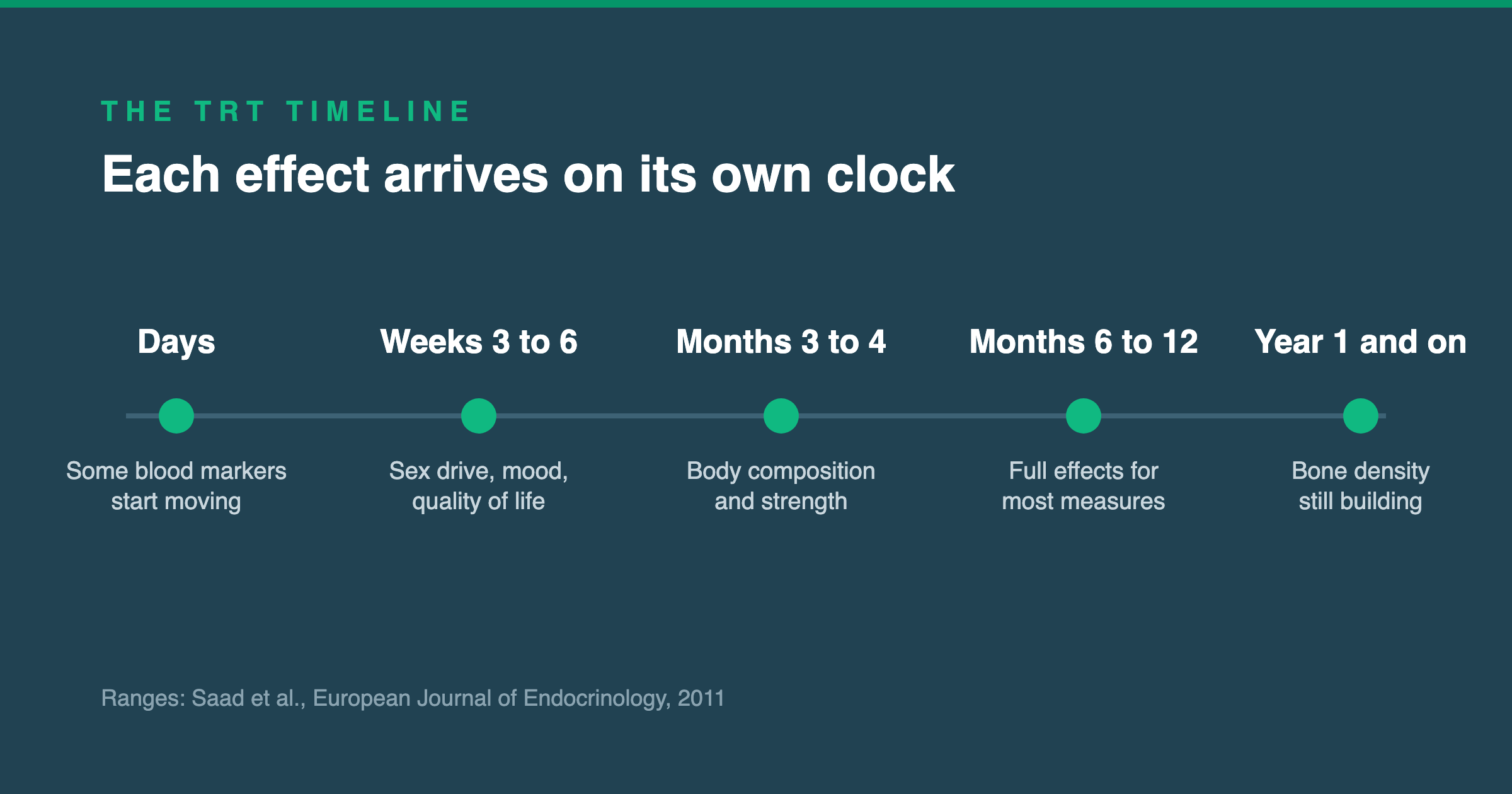
Testosterone replacement therapy is prescription testosterone taken to bring clinically low levels back into the normal range. Sex drive picks up at about three weeks, and the full effects take six to twelve months to arrive. Those ranges come from a 2011 review in the European Journal of Endocrinology that pooled the published trial data on when each effect of testosterone treatment first appears and when it peaks. So "how long does TRT take to work" has a different answer for each effect. A man who is a month in and feels nothing yet is still inside the published ranges. This article lays the timeline out effect by effect, then covers what changes it and how to tell whether low testosterone was the wrong diagnosis.
Hill Tribe is a concierge men's health clinic in Tampa, and our model is labs first: a comprehensive blood panel and a diagnosis before any prescription. The American Urological Association and Endocrine Society guidelines on testosterone therapy supply the diagnosis and monitoring numbers below. The ranges tell you roughly what to expect month by month. If a follow-up result falls outside them, tell your provider.
How long TRT takes to work, effect by effect
Sexual interest is the first change men tend to notice, appearing after about three weeks and plateauing at six, with no further increase expected beyond that. Insulin sensitivity may improve within days of the first dose, though you will not feel that change. Mood improves after three to six weeks in the pooled trials, and the improvement keeps growing until 18 to 30 weeks. Quality-of-life scores begin to improve within three to four weeks. Erections and ejaculations respond more slowly and can take up to six months.
Fat mass, lean mass, and muscle strength change more slowly, with measurable differences arriving within 12 to 16 weeks. Those changes stabilize at 6 to 12 months, and small gains can continue for years. Cholesterol numbers begin shifting at four weeks and reach their maximum change at 6 to 12 months. Glycemic control, the thing your A1c measures, takes 3 to 12 months to change. Bone density takes the longest: changes are detectable at six months and still improving at three years.
Red blood cell production also rises on testosterone, with the effect evident at three months and peaking at 9 to 12 months, so the guidelines have clinics measure hematocrit before treatment and during it. PSA, the prostate marker, rises slightly and plateaus at 12 months, and the review notes that a further increase should be related to aging rather than therapy. You will not feel either number change; both come from a blood draw.
| Effect | First change | Peak |
|---|---|---|
| Sexual interest | about 3 weeks | 6 weeks, then plateau |
| Depressive mood | 3 to 6 weeks | 18 to 30 weeks |
| Quality of life | 3 to 4 weeks | later; the review gives no fixed point |
| Erections and ejaculations | not separately reported | up to 6 months |
| Fat mass, lean mass, strength | 12 to 16 weeks | 6 to 12 months, small gains for years |
| Cholesterol (lipids) | 4 weeks | 6 to 12 months |
| Glycemic control | insulin sensitivity within days | 3 to 12 months |
| Red blood cell production | 3 months | 9 to 12 months |
| Bone density | 6 months | still improving at 3 years |
All figures from Saad et al., European Journal of Endocrinology, 2011.
Why your timeline may run longer or shorter
The review attributes the spread between men partly to the pharmacodynamics of the preparation, meaning how the specific form of testosterone behaves in the body over time. On one standard symptom questionnaire for aging men, the studies it pooled showed improvement at one to three months with injectable testosterone undecanoate and at about nine months with a testosterone gel. At Hill Tribe you can get testosterone as injections, topical preparations, or other forms filled through licensed compounding pharmacies. Genetics contribute too: the review credits differences in the androgen receptor and in how cells process the hormone for part of the variation, and neither is something you can test for in advance. Your provider controls the dose: the first follow-up draw shows how your body responded, and the dose gets adjusted from there. The Endocrine Society guideline has clinicians aim for testosterone concentrations in the mid-normal range during treatment.
When no change means something else
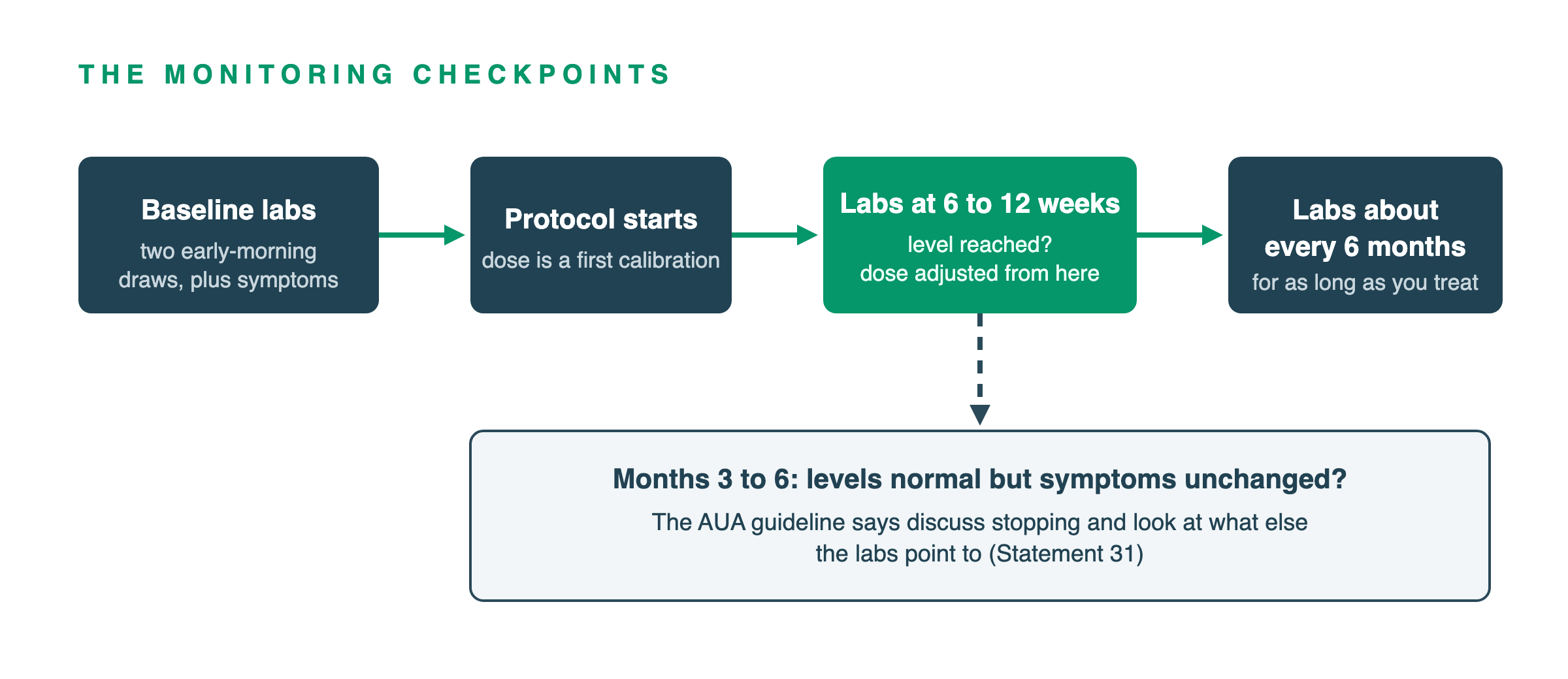
The American Urological Association tells clinicians to discuss stopping testosterone therapy three to six months after starting it in patients whose total testosterone normalized but who saw no improvement in symptoms or signs. If that describes you, ask your provider about that discussion and bring your lab results. Some men's panels show a thyroid or metabolic problem instead, and they leave a Hill Tribe results review with a thyroid referral or a metabolic plan. The same guideline defines the diagnosis as two total testosterone measurements below 300 ng/dL, taken on separate early-morning occasions, combined with symptoms. Also ask what time of day your diagnostic levels were drawn.
The checkpoints while you wait
The AUA has clinicians measure an initial follow-up total testosterone level after starting therapy, to confirm the target level has been reached, and then re-measure every 6 to 12 months for as long as treatment continues. The Endocrine Society's monitoring plan adds symptom review, hematocrit measurement, and an evaluation of prostate cancer risk during the first year of therapy. At Hill Tribe, follow-up labs come at 6 to 12 weeks after starting and then about every six months, and the provider who set up your treatment plan reviews them. At those reviews the provider adjusts the dose and manages estradiol. Both guidelines call for blood draws after you start, so a follow-up that is only a refill link with no lab work is not what they describe. Check any clinic against those two documents, including ours.
Where to start
If you have not started TRT, book the draw: a morning blood panel at a Quest Diagnostics location near you, reviewed line by line with Caite, our ARNP. Most new patients are seen the same week. If you are already on TRT somewhere else and past month six with no change, book the same consult and bring your labs; we will review them.